

How to Choose Ethical Coffee Beans You Can Actually Trust
Last Updated: November 15, 2026
Quick Summary
To choose ethical coffee beans, read the bag in two passes: first note the certification seals and origin, then look for a named farm, cooperative, or washing station, altitude, variety, and harvest year. A certification logo proves an audit was paid for, not that the farmer earned a living income, so ask for a published farm-gate price and sourcing report.
- Fair Trade sets a minimum price floor and social premium, but does not guarantee the farmer's total income covers costs.
- Direct trade is not a protected term, so ask who the producer is and how long the relationship has run.
- A farm-gate price is the most useful figure because it shows what actually reached the farmer.
- A high shelf price does not automatically mean a high payment to the farmer.
- The Single Origin Favorites Sample Pack gives you six 2oz packs to compare origins side by side.
Table of Contents
- Start With the Label, Then Look Past It
- Coffee Sourcing Certifications and What They Actually Verify
- Direct Trade Coffee: Stronger Relationships, Weaker Standards
- What Farmers Are Actually Paid and How to Read Price Claims
- Spotting Greenwashing in Coffee Marketing
- How to Assess Ethically Sourced Coffee Brands Before You Buy
- Sustainable Coffee Beans: Traceability Beyond the Country Name
- Build Your First Ethical Coffee Order at Calamotti Coffee
- Frequently Asked Questions
Start With the Label, Then Look Past It
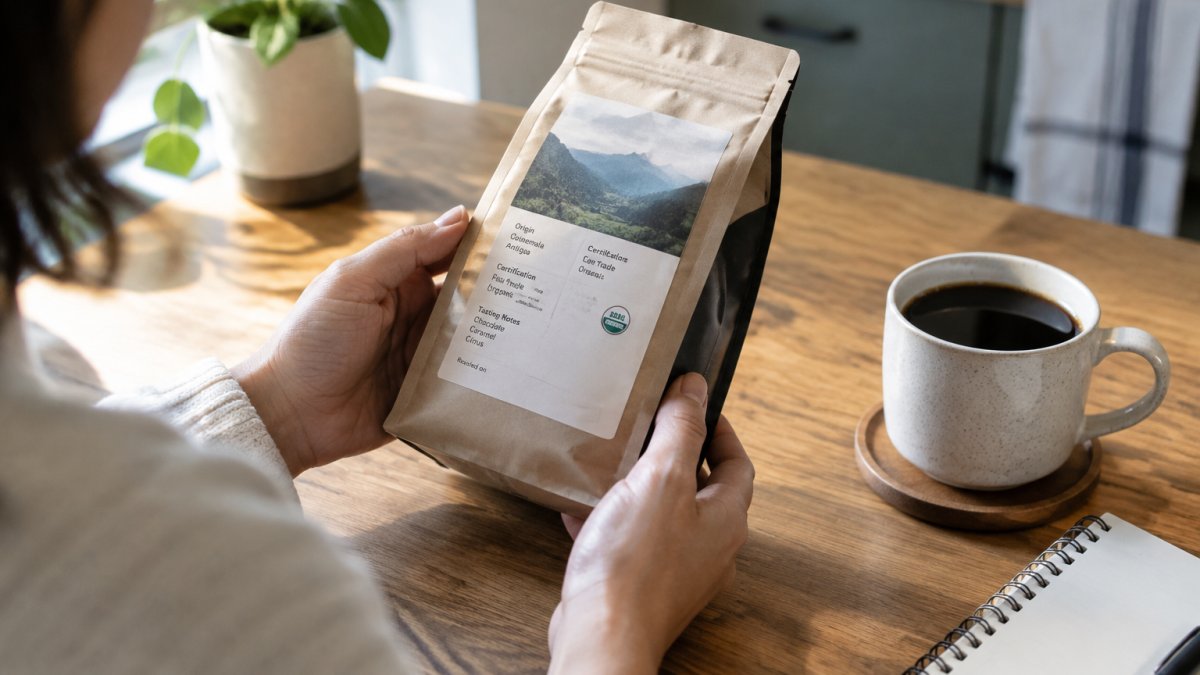
Learning how to choose ethical coffee beans starts with the bag in your hand. The label tells you a lot, but it rarely tells you the whole story.
Here is the core problem. A certification logo proves a roaster paid for an audit. It does not prove the farmer behind your cup earned a living income. Those are two different claims, and most shoppers treat them as one.
So read the label in two passes.
Pass one: what the bag claims.
- Certification seals (Fair Trade, Rainforest Alliance, Organic)
- Origin country, sometimes region
- Roast level and tasting notes
Pass two: what the bag actually reveals.
- Named farm, cooperative, or washing station
- Altitude and variety
- Harvest year
The second pass is where trust gets built. A bag that names a cooperative and a region is doing more work than one that just says "Product of Colombia."
Coffee Sourcing Certifications and What They Actually Verify
Coffee sourcing certifications are third-party programs that audit farms and supply chains against a set of social, environmental, or quality standards. Each one verifies something specific, and each one leaves gaps.
Fair Trade, Rainforest Alliance, and Organic Compared
| Certification | What It Verifies | What It Misses |
|---|---|---|
| Fair Trade | Minimum price floor, social premium paid to cooperatives | Does not guarantee the farmer's total income covers costs |
| Rainforest Alliance | Environmental practices, shade management, some labor standards | Does not set a price floor |
| Organic | No synthetic pesticides, separate handling | Says nothing about farmer pay or labor rights |
Fair Trade sets a minimum price and a community premium, which helps stabilize income when market prices fall. Rainforest Alliance focuses on how coffee is grown, including biodiversity and shade-grown practices. Organic certification covers pesticide use and processing, not wages.
A common mistake is assuming one seal covers everything. It does not. Many roasters stack certifications for this reason.
For a fuller picture of how these standards are defined, the Fairtrade International standards explain the price and premium mechanics in detail.
Direct Trade Coffee: Stronger Relationships, Weaker Standards
Direct trade coffee is coffee bought through a direct relationship between a roaster and a producer, without a certification body in the middle. That relationship can mean better prices and real communication. It can also mean no independent auditing at all.
The trade-off is simple. Direct trade offers flexibility and often closer producer relationships. It does not offer third-party verification, because there is no third party.
What most guides miss is this: "direct trade" is not a protected term. Any roaster can print it on a bag. The question to ask is not "do you do direct trade?" but "who is the producer, and how long have you worked with them?"
Good signs include:
- A named farm or cooperative
- Details about how many years the relationship has run
- A stated farm-gate price or premium
- Visit notes or harvest updates
If a roaster cannot answer those questions, the "direct" claim is doing very little work.
What Farmers Are Actually Paid and How to Read Price Claims
Farmer pay is the hardest thing to verify from a coffee bag, and the most important. Most price claims on packaging are vague by design, so the skill to build is reading the mechanism behind the number rather than the number itself.
Here is how the common price terms actually work.
"Premium paid above market price" means the roaster paid more than the commodity rate, usually the New York "C" futures price plus a differential. It does not say how much more, whether the premium reached the farmer or stayed with an exporter, or whether the total covers the cost of production.
"Farm-gate price" refers to what the producer received at the farm, before transport, milling, export, and financing costs. This is the most useful figure because it shows what actually reached the farmer.
"Minimum price" is a floor set by a certification program, not a payment guarantee. Fairtrade International publishes a minimum price for conventional and organic coffee, plus a separate social premium paid to the cooperative.
"Living income" is a benchmark, not a payment. It describes what a household needs to cover a decent standard of living in a given region, and it is calculated differently by different organizations. A roaster claiming to pay a "living income" should be able to say which benchmark they used and for which origin.
A practical rule: a roaster who publishes a farm-gate price and the harvest year is showing you their math. A roaster who publishes only a certification logo is asking you to trust theirs.
Watch out: a high price on the shelf does not automatically mean a high payment to the farmer. Specialty pricing and farmer pay are related, but they are not the same number, and a roaster's margin, roasting loss, and packaging costs all sit between the two.
When you compare claims across origins, remember that a figure that looks low in one country may be competitive in another because land, labor, and processing costs differ. The honest comparison is not "which roaster pays the biggest number" but "which roaster publishes enough detail that you can see how the number was reached."
Spotting Greenwashing in Coffee Marketing
Greenwashing in coffee usually shows up as language that sounds ethical but says nothing verifiable. The fix is to look for specifics.
Red flags to check:
- Vague origin claims. "Sourced from small farmers" without a country, region, or name.
- Borrowed credibility. A certification logo with no certificate number or program name.
- Emotional language over data. "Ethically sourced" with no sourcing report behind it.
- No traceability. A blend that hides every origin behind a single generic label.
Ask a roaster for their sourcing report. A confident one will send it.
How to Assess Ethically Sourced Coffee Brands Before You Buy
Assessing ethically sourced coffee brands comes down to a repeatable method, not a single checklist. Use this three-step process before you commit to a subscription or a full bag.
Step one: read the bag for specificity.
- Does the bag name a farm, cooperative, or washing station?
- Is the region specific, not just the country?
- Is there a certification, and do you know what it verifies?
- Does the roaster publish any farm-gate price or premium?
- Is there a sourcing report or producer page on the website?
- Can you contact the roaster and get a straight answer?
- Does the roast date appear on the bag?
That last point matters more than people think. Freshness and ethics travel together. A roaster who prints a roast date is tracking the coffee closely.
Step two: weigh the claims against each other. No coffee meets every ideal, so decide what you prioritize. If farmer income matters most, look for a published farm-gate price or a named producer relationship. If environmental practices matter most, look for organic certification or shade-grown details. If labor conditions matter most, look for a certification that audits labor and a roaster who can describe working conditions. A common pattern is that a roaster strong on one dimension is weaker on another; the goal is to know which trade-off you are accepting rather than to find a perfect bag.
Step three: verify by asking. A confident roaster will answer specific questions. Ask for the sourcing report, the name of the cooperative or farm, the harvest year, and how long the relationship has run. Ask what the certification covers and what it does not. Ask whether the farm-gate price is per pound of green or roasted coffee. A vague answer is itself information.
Watch out: a certification logo with no certificate number or program name is borrowed credibility, and a sourcing page that lists only countries is not traceability. The evidence standard is a named producer, a stated relationship length, and a price or premium figure you can interpret.
You can apply this method to a single origin like our Uganda coffee or our Kenya coffee and see how much detail a bag actually gives you.
Sustainable Coffee Beans: Traceability Beyond the Country Name
Sustainable coffee beans are beans grown and traded in a way that protects the land, the farmer, and the long-term supply. Traceability is how you check that claim.
Country-level origin is the weakest form of traceability. "Colombia" tells you a border, not a farm. Region-level is better. Farm or cooperative level is best, and altitude and variety details usually come with it.
Coffee cooperatives matter here. A cooperative pools small-scale farmers so they can share processing equipment and negotiate together. When a bag names a cooperative, you can often trace the coffee to a specific growing community.
Climate resilience and biodiversity tie in too. Shade-grown coffee protects soil and wildlife, and it buffers farmers against rising temperatures. Those practices show up in the details, not the slogans.
Our Peru coffee pods and Bali coffee pods list the grower, region, altitude, and varieties, which is exactly the level of detail to look for.
Build Your First Ethical Coffee Order at Calamotti Coffee
Choosing ethical coffee beans gets easier once you know what to check. Start with the label, look past the seal, and ask for the details behind the claim.
If you want to try several origins before committing, the Single Origin Favorites Sample Pack gives you six 2oz packs to compare side by side. It is the easiest way to find the cup that fits your morning.
Ready to taste the difference traceability makes? Calamotti Coffee brings you hand-selected, small-batch roasted beans delivered fresh, with the origin details printed right on the bag. Start with a sample pack and find your favorite.
Frequently Asked Questions
Which coffee certifications should I look for when buying ethical coffee beans?
Fair Trade focuses on minimum prices and premiums for producers, Rainforest Alliance covers environmental and social criteria including biodiversity and shade-grown practices, and organic certification verifies farming without prohibited pesticides. Bird Friendly adds habitat requirements. No single seal covers everything, so check which certification matches what you care about most, then confirm the roaster names the farm or cooperative behind the bag.
Is direct trade coffee more ethical than Fair Trade certified coffee?
Not automatically. Direct trade coffee means a roaster buys straight from producers, which can mean better prices and closer relationships, but there is no independent third-party verification of the terms. Fair Trade sets a minimum price and premium that an auditor checks. The strongest option is a roaster that does both: direct relationships plus published details on who grew the coffee and what was paid.
How can I check whether a coffee brand pays farmers fairly?
Look for a sourcing report or origin page that names the cooperative or farm and states the price paid or the premium above the commodity market. Ask the roaster directly by email what farm-gate price they paid this harvest. Brands with real relationships answer with specifics; vague answers about 'partnerships' and 'community investment' without names or figures are a warning sign.
What does ethically sourced coffee mean in practice?
It means the beans were grown and traded under conditions that protect farmers, workers, and the environment. In practice that shows up as a traceable origin down to a farm or cooperative, a price that supports farmer income, safe working conditions, and farming methods that limit pesticide use and deforestation. You verify it through certifications, roaster transparency, and published sourcing details, not through marketing language alone.
