

How Often Should Coffee Be Roasted? A Home Guide
Table of Contents
- How Often Should Coffee Be Roasted? The Short Answer
- How Long to Rest Coffee After Roasting
- How Long Do Roasted Coffee Beans Stay Fresh?
- A Batch-Size Calculator Based on Daily Coffee Use
- How to Store Roasted Coffee Beans for Maximum Freshness
- Signs Coffee Beans Are Stale (and How to Avoid Them)
- Roasting Frequency vs. Rest Time: What's the Difference?
- Conclusion: Matching Your Roasting Schedule to Your Daily Ritual
- Frequently Asked Questions
Last Updated: October 14, 2026
How Often Should Coffee Be Roasted? The Short Answer
For most home setups, coffee should be roasted in small batches every one to two weeks, timed to match how fast you actually drink it. If you go through a bag in ten days, roast every ten days.
At Calamotti Coffee, we roast in small batches and ship fast for exactly this reason: freshness is not a date on a bag, it is a clock that starts the moment the beans leave the roaster. Most people assume the roast date matters less than the brand. It matters more.
The rest of this guide gives you a batch-size calculator, storage rules, and separate schedules for home, café, and commercial roasting. First, let us clear up the biggest confusion.
How Long to Rest Coffee After Roasting
Roasted coffee needs to rest for two to seven days before it tastes its best, depending on the brew method. This rest period is called degassing, and it happens because freshly roasted beans release carbon dioxide. Brew too soon and that gas fights the water, giving you a flat, uneven cup.
The ideal rest window shifts with your brew method:
- Espresso: 7 to 9 days. Espresso needs the most rest because pressure magnifies any inconsistency.
- Pour-over and drip: 2 to 5 days. These methods are more forgiving.
- French press: 3 to 7 days. The long steep handles young beans well.
- Cold brew: 5 to 10 days. Cold water extracts slowly, so older beans work fine.
Roast level changes this too. Dark roasts degas faster because the roasting process has already opened up the bean. Lighter roasts hold their gas longer and often need a few extra days.
How Long Do Roasted Coffee Beans Stay Fresh?
Whole roasted coffee beans stay fresh for about one to three weeks after the roast date, then fade steadily. Ground coffee loses its peak in days, not weeks, because grinding exposes far more surface area to oxygen.
Here is the rough timeline most roasters work with:
| Stage | Time After Roast | What Is Happening |
|---|---|---|
| Too fresh | 0-2 days | Heavy degassing, uneven extraction |
| Peak flavor | 2-14 days | Aroma and flavor at their best |
| Still good | 15-21 days | Slight flattening, still enjoyable |
| Fading | 3-6 weeks | Aroma drops, taste turns dull |
| Stale | 6+ weeks | Flat, papery, lifeless |
That table is a starting point, not a rule. The real peak window shifts with the bean, the roast level, and how you brew it. A light-roasted Ethiopian natural may hit its stride on day 5 and hold until day 18. A dark-roasted espresso blend may peak on day 8 and fall off by day 14. Most practitioners find the window is narrower for espresso and wider for filter.
How to Track Your Own Peak Window
Instead of trusting a generic number, run a simple roast-date log. It takes two minutes per brew and tells you exactly when each batch tastes best.
- Write the roast date on the bag the day it arrives or the day you roast.
- Each time you brew, note the days-after-roast and a one-word impression: flat, good, great, fading.
- Repeat across the whole bag. After two or three bags of the same coffee, a pattern appears.
- Mark the day range where you wrote "great" most often. That is your peak window for that bean, roast level, and brew method.
A common pattern for home brewers:
- Filter, light roast: peak around days 4-12
- Filter, dark roast: peak around days 3-9
- Espresso, medium roast: peak around days 7-14
- Espresso, dark roast: peak around days 5-10
Green coffee, by contrast, keeps for six to twelve months when stored well. That is why roasters buy green and roast to order rather than roasting everything at once.
The takeaway: buy whole beans, check the roast date, log your tastings, and plan to finish the bag within three weeks.
A Batch-Size Calculator Based on Daily Coffee Use
The right batch size comes from your daily coffee consumption, not from a recipe.
Here is the formula:
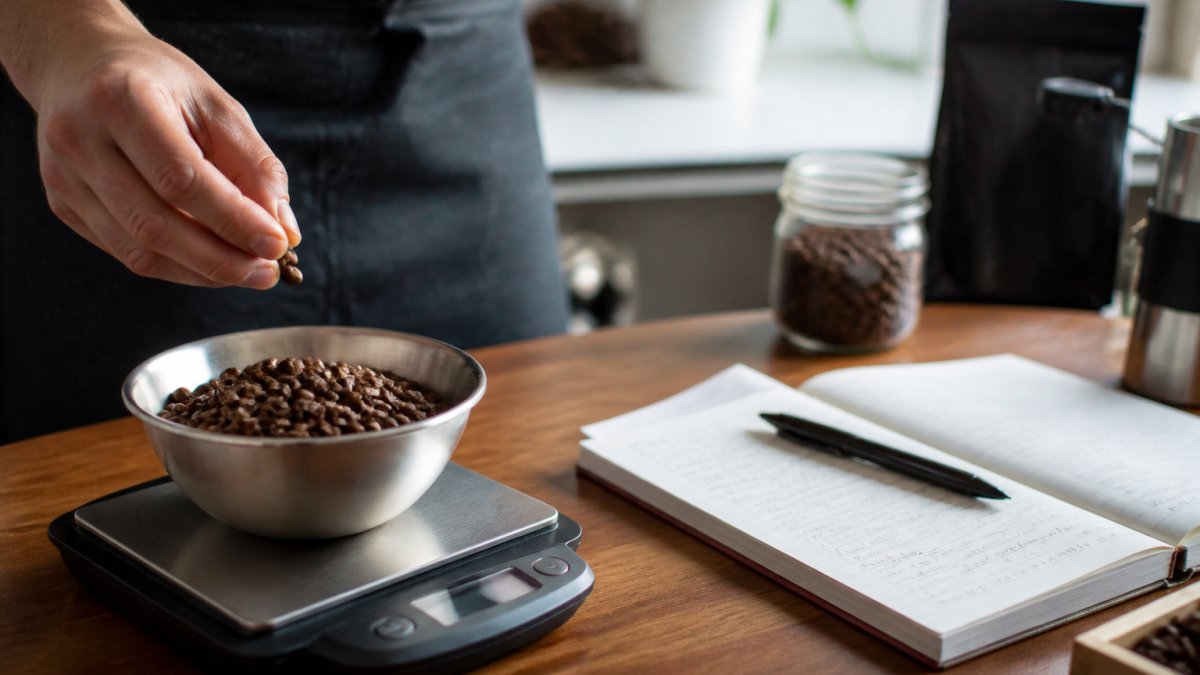
Batch size (grams) = daily use (g) × days per batch × 1.1
The 1.1 adds a 10% buffer for dialing in your grinder and the occasional bad shot.
A worked example:
- You brew 30 g of beans per day
- You want each batch to last 10 days
- 30 × 10 × 1.1 = 330 g per roast batch
For a café, the same math scales up. A shop pulling 200 shots a day at 18 g each uses 3.6 kg daily, so a two-day batch is roughly 7.2 kg.
How to Store Roasted Coffee Beans for Maximum Freshness
Storing roasted coffee beans well means blocking four enemies: oxygen, moisture, heat, and light. An airtight container with a one-way valve is the standard tool, because the valve lets carbon dioxide escape without letting oxygen in.
Follow these rules:
Single Origin Favorites Sample Pack →
- Keep beans whole and grind right before brewing
- Store in an opaque, airtight container, not a clear jar on the counter
- Keep the container in a cool, dark cupboard, away from the stove
- Skip the fridge; moisture and odors ruin beans
- Freeze only for long storage, in sealed portions you thaw once
The freezer works if you do it right. Portion beans into single-use bags, squeeze out the air, and thaw a bag fully before opening it. Repeated thawing pulls moisture into the beans and kills the flavor.
How Storage Changes Your Roasting Schedule
Storage is not just a preservation step, it directly changes how often you should roast. Better storage stretches the usable window, which means you can roast larger batches less often. Poor storage shrinks the window, which means you either roast smaller batches more often or accept flat coffee.
Here is how the main storage methods shift the schedule:
- One-way valve bag, sealed, cupboard: roughly the standard 2-3 week window. Roast every 1-2 weeks for home use.
- Airtight canister with valve: similar to a valve bag, sometimes a day or two longer if you purge the headspace.
- Vacuum-sealed portions: can extend peak flavor by several days to a week. You can roast a larger batch and split it into weekly portions.
- Freezer, single-use portions: the longest option. Beans frozen at peak and thawed once can taste close to fresh for one to three months. This lets you roast a month of coffee in one session instead of every week.
- Paper bag or open jar: days, not weeks. If this is your setup, roast small and roast often.
A practical rule: match your batch size to your storage. If you only have a valve bag and a cupboard, roast a one-to-two-week supply. If you vacuum-seal or freeze in portions, you can roast a three-to-four-week supply without losing quality.
For cafés and commercial roasters, storage is part of the workflow. Beans are often kept in valve-lined bins or sealed bags and rotated on a first-in, first-out basis. The roast schedule is then set by sales volume, not by storage limits, because turnover is fast enough that beans rarely sit long.
Signs Coffee Beans Are Stale (and How to Avoid Them)
Stale coffee shows clear signs long before you taste it. The most obvious is smell: fresh beans hit you with aroma the moment you open the bag, while stale beans smell like cardboard or nothing at all.
Watch for these signals:
- No aroma when you open the bag
- Beans look dry and dull instead of slightly oily
- The grind clumps less and flows like sand
- Brewed coffee tastes flat, papery, or sour with no sweetness
- Espresso pours fast and thin, with pale crema
Oxidation is the main cause. Every time air touches the beans, it slowly breaks down the oils that carry flavor. That is why a one-way valve bag and a tight seal matter so much.
If your beans have gone stale, do not toss them. Use them for cold brew, which masks flatness better than hot methods.
Roasting Frequency vs. Rest Time: What's the Difference?
Roasting frequency and rest time are two separate clocks, and mixing them up causes most home-roasting frustration. Frequency is how often you run the roaster.
Think of it this way:
- Frequency answers "how often should coffee be roasted?" It sets your calendar.
- Rest time answers "when is this batch ready to drink?" It sets your brew day.
A home roaster might roast every Sunday and rest each batch four days. A café might roast twice a week and rest espresso for eight days. The two numbers move independently.
For home roasting, a common approach is one roast session every one to two weeks, sized to your consumption. For cafés, two to three sessions a week keeps the rotation fresh.
Safety and upkeep matter between sessions. Clean the chaff tray, check the drum, and let the roaster cool fully before the next run. A dirty roaster smokes and scorches, which shows up in the cup.
Conclusion: Matching Your Roasting Schedule to Your Daily Ritual
The honest answer to how often should coffee be roasted is: as often as your consumption demands, and no more. Roast in small batches, rest each one for two to seven days, and finish the bag within three weeks. That rhythm keeps every cup at its peak.
If you would rather skip the roaster entirely, Calamotti Coffee does the timing for you. We hand-select beans from the finest farms, roast them in small batches, and deliver them fresh to your door. Our single-origin lineup, including our Single Origin Favorites Sample Pack, lets you taste the difference freshness makes.

Subscribe to our emails and get fresh, small-batch coffee delivered on a schedule that matches your daily ritual.
Frequently Asked Questions
How often should you roast coffee beans at home?
For most home roasters, roasting once a week in batches sized to your daily coffee consumption works well. If you drink two cups a day, a 250-gram batch covers roughly seven to ten days. Roasting more frequently in smaller amounts keeps coffee closer to its peak flavor window, but it also means more sessions and more cleanup. The key is matching your roasting cadence to how quickly you actually drink the coffee.
How long should coffee rest after roasting before brewing?
Resting period varies by brew method. Espresso typically needs seven to nine days of rest after roasting for stable extraction and good crema. Pour-over and drip methods often taste best after two to seven days. French press can be ready in as little as two to four days. Medium and dark roasts degas faster than light roasts, so adjust your resting period based on the roast level and how you brew.
How can you tell if coffee beans are past their peak?
Stale coffee beans lose their aroma, taste flat or papery, and may smell like cardboard or damp basement. Fresh beans have a noticeable scent when you open the bag and feel slightly oily or matte depending on roast level. If your brewed coffee tastes hollow or sour without sweetness, the beans are likely past their freshness window. Whole beans stored in an airtight container with a one-way valve last longer than pre-ground coffee.
Should you roast only as much coffee as you need?
Roasting in batches sized to your weekly consumption keeps coffee within its peak freshness window. A batch-size calculator helps: multiply your daily coffee dose by seven to ten days, then round up to the nearest roast batch size your equipment handles. For example, if you use 30 grams per day, a 250-gram batch covers about eight days. Smaller, more frequent roasts mean fresher cups but more sessions.